



Table of Content
- The Changing Landscape of Border Security
- The Growing Complexity of Border Security
- What Is a Unified Command Center?
- How UCCs Transform Border Security Operations
- How UCCs Strengthen Crisis Management Capabilities
- From Fragmentation to Fusion: The Strategic Advantage
- Introducing PertSol Centralized Monitoring Centre Solution
- Conclusion
The Changing Landscape of Border Security
Borders today are no longer static geographical boundaries. They are dynamic environments shaped by cross-border movement, geopolitical tensions, organized crime, climate-driven events, smuggling networks, cyber influence, and rapidly evolving security threats. From infiltration attempts and organized crime to humanitarian crises and natural disasters, border agencies are expected to respond faster, coordinate better, and act with precision, often under intense pressure.
The Growing Complexity of Border Security
Traditional border security models often operate in silos, with separate systems for surveillance, communications, intelligence, logistics, and emergency response. While these systems may function effectively in isolation, they struggle to provide clarity and coordination during fast-moving, high-stakes situations.
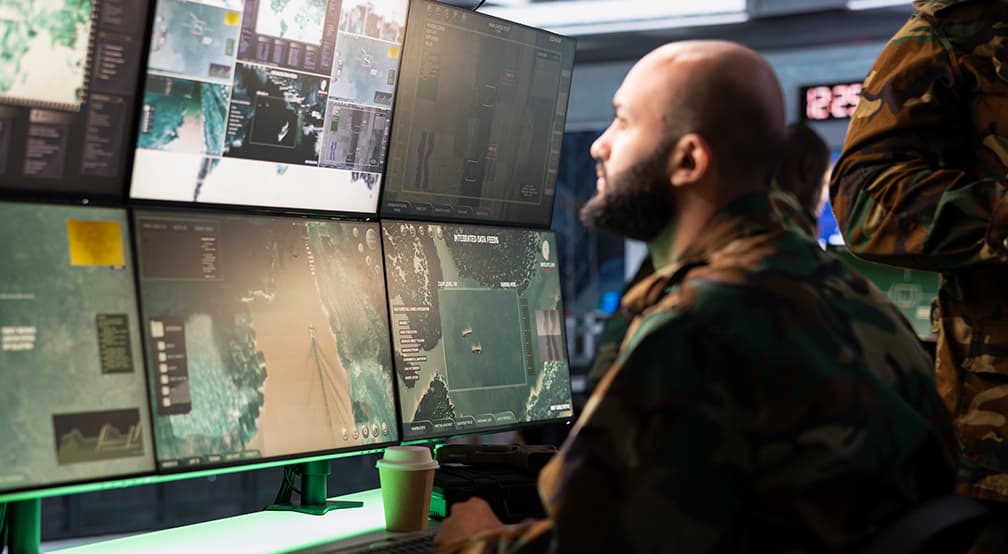
The lack of real-time data sharing and unified command frequently results in fragmented situational awareness and delayed decision-making.
Modern border challenges further amplify these limitations, including:
- Coordinated intrusions: Cross-border trafficking and organized networks
- Encrypted communications: Digital platforms used by hostile actors
- Mass migration events: Conflict or climate-driven displacement
- Environmental disasters: Impacting border regions and infrastructure
- Multi-agency complexity: Defense, police, customs, intelligence, and emergency teams
In the absence of unified visibility and communication, agencies risk information gaps, slow response times, inefficient resource utilization, and operational blind spots, undermining both security effectiveness and crisis response outcomes.
What Is a Unified Command Center?
A Unified Command Center is a centralized operational environment that integrates people, processes, and technology to deliver real-time situational awareness and coordinated control across complex operations.
At its core, a UCC:
- Aggregates data from multiple operational and intelligence sources into a single, unified view
- Enables real-time monitoring, analysis, and informed decision-making
- Facilitates seamless coordination across agencies and jurisdictions
- Supports both routine operations and high-impact crisis scenarios
Rather than replacing existing systems, a Unified Command Center connects, orchestrates, and contextualizes them, enabling representatives from multiple agencies to operate from a shared environment with seamless communication and coordinated decision-making.
How UCCs Transform Border Security Operations
Modern border security demands speed, clarity, and coordination across multiple agencies and domains. Unified Command Centers provide the operational foundation for this transformation by consolidating intelligence, enabling real-time awareness, and synchronizing response actions which turn complex, fast-evolving situations into controlled, intelligence-led operations.
1. Single Source of Truth
UCCs consolidate data from surveillance systems, sensors, communication intercepts, location intelligence, field units, and intelligence repositories into a unified operational view—ensuring consistent, reliable information for all stakeholders.
2. Real-Time Situational Awareness
Live feeds, alerts, and analytics enable early detection of abnormal movements, border breaches, and coordinated activities, allowing commanders to assess threats and act before situations escalate.
3. Faster, Coordinated Response
By operating from a shared command framework, defense forces, law enforcement, intelligence, and emergency teams can assign tasks, track assets, and adapt response strategies in real time.
4. Intelligence-Driven Border Control
Correlation of historical data with live inputs enables predictive insights into adversary routes, tactics, and timing, which allows shifting border operations from reactive patrols to proactive control.
5. Optimized Resource Deployment
Unified visibility of personnel, vehicles, and aerial assets allows precise resource allocation, reducing duplication and maximizing operational effectiveness across border zones.
How UCCs Strengthen Crisis Management Capabilities
Crisis situations, whether natural disasters, humanitarian emergencies, or large-scale security incidents, demand rapid coordination, clear command structures, and accurate, real-time information. Unified Command Centers provide the operational backbone that enables authorities to manage crises with speed, clarity, and control. Unified Command Centers provide the operational backbone that enables authorities to manage crises with speed, clarity, and control.
1. Disaster & Humanitarian Response
UCCs centralize coordination of rescue operations, evacuation planning, and resource deployment during natural disasters or humanitarian emergencies—ensuring faster, safer, and more organized response efforts.
2. Cross-Agency Coordination
By providing a shared operational environment, UCCs align multiple authorities under a common action plan, enabling synchronized decision-making and reducing delays caused by fragmented command structures.
3. Data-Driven Decision Making
Real-time data feeds and incident dashboards give commanders clear visibility into evolving situations, enabling informed decisions under pressure and minimizing reliance on incomplete or outdated information.
4. Evidence & Accountability
Centralized event logs, audit trails, and incident timelines ensure transparency and traceability, supporting post-incident analysis, legal review, and continuous improvement of crisis response frameworks.
From Fragmentation to Fusion: The Strategic Advantage
The true power of a unified command center lies in fusion; the ability to connect surveillance, communications, intelligence, analytics, and command workflows into one cohesive system. This fusion enables:
- Better risk assessment at borders
- Reduced response times
- Improved inter-agency trust and collaboration
- More informed strategic planning
In an era where threats are asymmetric and fast-evolving, fragmented systems are no longer sufficient.
Introducing PertSol Centralized Monitoring Centre Solution
At the heart of this transformation is the PertSol Centralized Monitoring Centre (CMC) Solution, designed to support mission-critical operations for border security, internal security, and crisis management agencies. It provides a unified, scalable, and secure command environment that brings together:
- Multi-source data ingestion from surveillance, interception, geospatial, and network systems
- Real-time monitoring, analytics, and alerting across operational domains
- Integrated case, target, and incident management
- AI-assisted correlation and visualization for faster decision-making
- Secure, role-based access and full auditability
By enabling a single operational view across agencies and technologies, the solution empowers authorities to detect earlier, respond faster, and coordinate smarter, whether securing national borders or managing large-scale crises.
Conclusion
Border security and crisis management are no longer about isolated systems or standalone responses. They demand unity of intelligence, operations, and command. Unified command centers represent this shift, transforming complexity into clarity and fragmentation into coordinated action.
As borders grow more dynamic and crises more interconnected, solutions like PertSol’s Centralized Monitoring Centre will play a pivotal role in building resilient, responsive, and future-ready security architectures.