



Table of Content
- The Fragility of Modern Borders
- Deconstructing Modern Border Disputes
- Limitations of Traditional Conflict Management
- Intelligence-Driven Border Stability: The Case for Integration
- Key Components of a Modern Intelligence Ecosystem:
- Observed Benefits of Intelligence Integration
- Conclusion: A Strategic Imperative for Peace
The Fragility of Modern Borders
Geopolitical tensions, unresolved border disputes, and shifting alliances continue to fuel global instability. In volatile regions, even seemingly minor incidents—such as unauthorized troop movements, cyber intrusions, or coordinated disinformation—can rapidly trigger diplomatic or military crises. With studies by defense and cybersecurity agencies indicating that over 70% of modern threats are now initiated or intensified through digital platforms, cyberspace has emerged as a dominant domain for strategic influence and conflict escalation.

Traditional tools like border patrols and diplomatic hotlines remain essential but increasingly inadequate. In today’s hybrid threat landscape, they must be reinforced with intelligence-led, technology-driven systems capable of real-time monitoring, predictive analytics, and rapid response.
This blog explores how an intelligence-led, technology-enabled approach—centered around centralized monitoring systems—can transform national border security strategies from reactive containment to proactive conflict prevention. It is tailored to inform law enforcement agencies, security policymakers, and intergovernmental defense planners seeking a resilient, integrated framework to mitigate cross-border flashpoints.
Deconstructing Modern Border Disputes
In today’s high-stakes geopolitical landscape, the risk of escalation along contested borders is amplified not just by the presence of historical disputes—but by the absence of timely intelligence, shared situational awareness, and coordinated response mechanisms.
Whether it’s a misinterpreted troop movement, a cyber-triggered misinformation campaign, or a communication breakdown on the ground, the failure to verify, attribute, and respond in real time often turns minor incidents into major diplomatic or military crises. The speed and unpredictability of such escalations demand a shift from reactive defense to intelligence-led, proactive conflict management.
This is where tech-enabled solutions—such as PertSol’s Centralized Monitoring Center—play a transformative role. Far beyond traditional surveillance, these integrated platforms empower nations to detect early warning signs, uncover behavioral patterns, and identify persons of interest through real-time, multi-domain intelligence fusion.
Limitations of Traditional Conflict Management
Traditional methods—relying on field intelligence, diplomatic protocols, and manual reporting—have long played a vital role in managing border tensions. However, as the pace and complexity of modern conflicts accelerate, there are inherent limitations to what human-led processes alone can achieve.
While indispensable, these approaches often require additional support from technology to keep up with real-time developments, analyze vast data streams, and reduce the margin for error in high-stakes decisions. Key challenges include:
- Delayed Threat Detection: Manual intelligence verification takes time, which can delay responses in fast-evolving situations.
- Fragmented Data Streams: Agencies often operate in silos, limiting the ability to create a unified intelligence picture.
- Lack of Predictive Capability: Without AI-powered analytics, it becomes difficult to anticipate emerging threats or behavioral patterns.
- Exposure to Information Warfare: Digital misinformation spreads rapidly, making it harder to maintain accurate narratives and diplomatic clarity.
By augmenting traditional practices with real-time analytics, centralized data access, and predictive modeling, modern solutions strengthen the hands of decision-makers—enabling faster, more informed, and coordinated responses without replacing human judgment.
Intelligence-Driven Border Stability: The Case for Integration
To prevent tactical incidents from escalating into strategic crises, governments need more than traditional border security—they need an integrated, intelligence-led approach. This requires real-time surveillance, predictive analytics, cross-domain data fusion, and seamless inter-agency coordination.
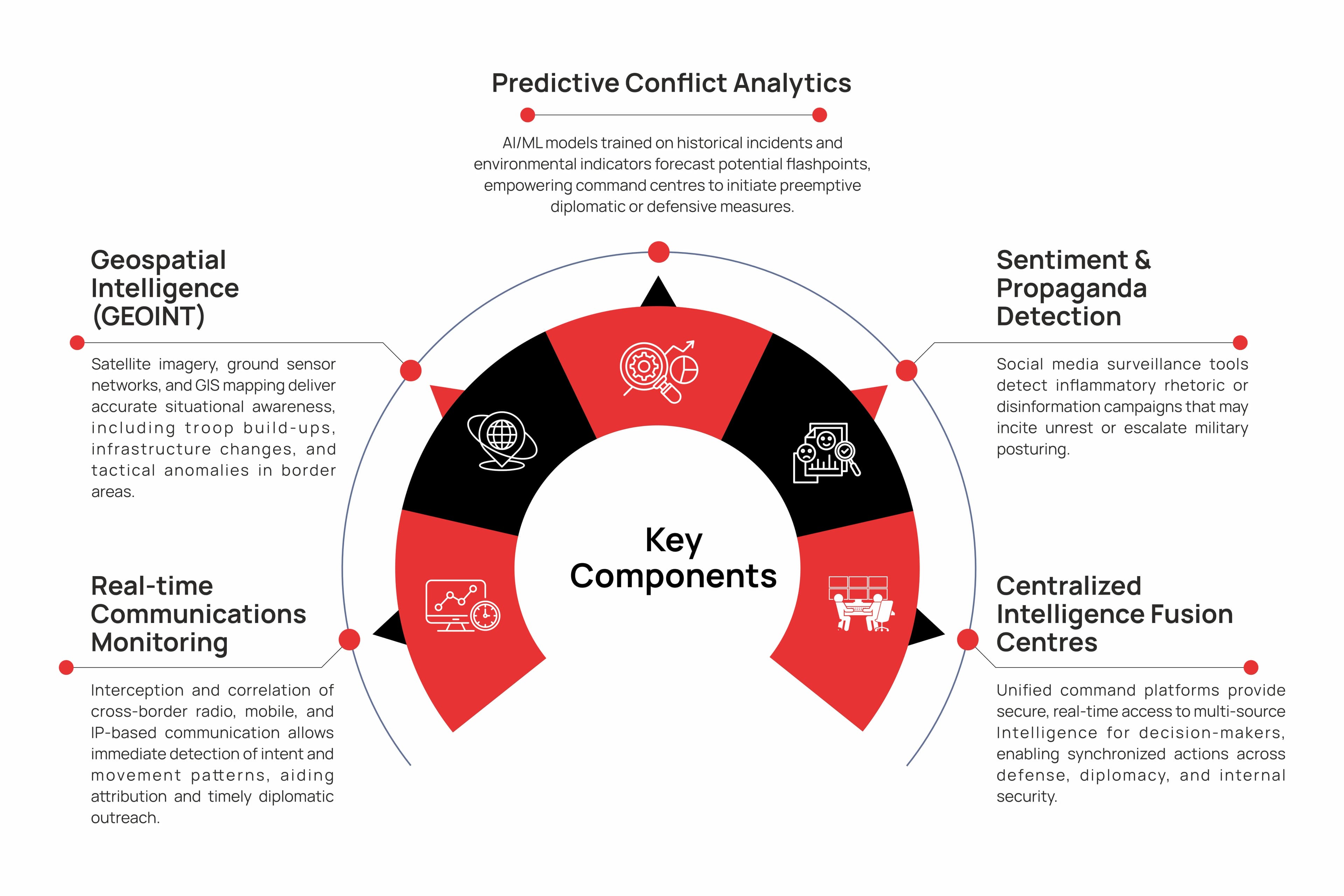
PertSol delivers exactly this through its Centralized Monitoring & Intelligence Solutions, designed specifically to empower law enforcement, defense, and homeland security agencies operating in high-risk border zones. Our platform consolidates critical data—from communication intercepts, geospatial intelligence, and social media sentiment to real-time surveillance feeds—into a unified operational view.
Key Components of a Modern Intelligence Ecosystem:
Observed Benefits of Intelligence Integration
While specific outcomes vary by region and implementation, case studies and field reports from governments and multilateral defense programs adopting integrated intelligence systems consistently highlight the following benefits:
- Rapid De-escalation: Real-time intelligence verification has enabled quicker incident assessment, allowing authorities to contain potential escalations through timely diplomatic or operational responses.
- Improved Inter-Agency Coordination: Unified access to intelligence reduces duplication, enhances transparency, and fosters greater collaboration across defense, diplomacy, and law enforcement agencies.
- Reduced Reliance on Military Force: Proactive alerts and predictive analytics have enabled decision-makers to rely more on diplomacy and evidence-led dialogue, minimizing the need for kinetic interventions.
- Crisis Mitigation: Early warning mechanisms have proven effective in triggering evacuation protocols or emergency preparedness measures—especially in disaster-prone or conflict-sensitive regions.
“These insights are drawn from defense modernization programs, NATO StratCom reports, and best practices shared by homeland security agencies in conflict-prone zones.”
Conclusion: A Strategic Imperative for Peace
In a world where national boundaries are increasingly challenged by both conventional and unconventional threats, reactive measures are no longer enough. Preventing the escalation of cross-border incidents requires the integration of advanced intelligence technologies with coordinated diplomatic frameworks.
Centralized monitoring Centers—powered by real-time data collection, multi-source analysis, and predictive modeling—offer a proven path to proactive de-escalation and sustained regional stability. For nations determined to protect their sovereignty and foster long-term peace, an intelligence-led border management strategy is no longer optional—it is essential.